<?xml version="1.0" encoding="utf-8"?><feed xmlns="http://www.w3.org/2005/Atom" ><generator uri="https://jekyllrb.com/" version="4.4.1">Jekyll</generator><link href="/feed.xml" rel="self" type="application/atom+xml" /><link href="/" rel="alternate" type="text/html" /><updated>2026-06-24T01:43:21+00:00</updated><id>/feed.xml</id><title type="html">Data Dive Craft</title><subtitle>Strategic data architecture, high-performance engineering and production-grade design with Augentic AI</subtitle><author><name>Krzyszof</name></author><entry><title type="html">Architecting Slowly Changing Dimensions (SCD Type 1 &amp;amp; Type 2) for Modern Data Platforms</title><link href="/insights-blog/architecting-scd-type1-type2/" rel="alternate" type="text/html" title="Architecting Slowly Changing Dimensions (SCD Type 1 &amp;amp; Type 2) for Modern Data Platforms" /><published>2026-03-12T14:00:00+00:00</published><updated>2026-03-12T14:00:00+00:00</updated><id>/insights-blog/architecting-scd-type1-type2</id><content type="html" xml:base="/insights-blog/architecting-scd-type1-type2/"><![CDATA[<h1 id="architecting-slowly-changing-dimensions-scd-type-1--type-2-for-modern-data-platforms">Architecting Slowly Changing Dimensions (SCD Type 1 &amp; Type 2) for Modern Data Platforms</h1>

<p>In my 13+ years of architecting enterprise data solutions—from legacy on-premises environments to modern cloud data lakehouses (Azure Databricks, Redshift, etc.)—few topics generate as much debate as historical data tracking.</p>

<p>Whether you are building out the Silver validation layer of a Medallion architecture or designing the final Gold dimensional tables for enterprise reporting, you must have a bulletproof strategy for how your data changes over time. If your dimensional models cannot accurately answer the question, “What did this record look like three years ago?” your reporting is fundamentally flawed.</p>

<p>This brings us to the core of data warehousing methodology: Slowly Changing Dimensions (SCDs). Specifically, defining the logic for Type 1 and Type 2 changes based on business keys.</p>

<p>Here is a deep dive into how I architect these solutions for scale, performance, and unshakeable data integrity.</p>

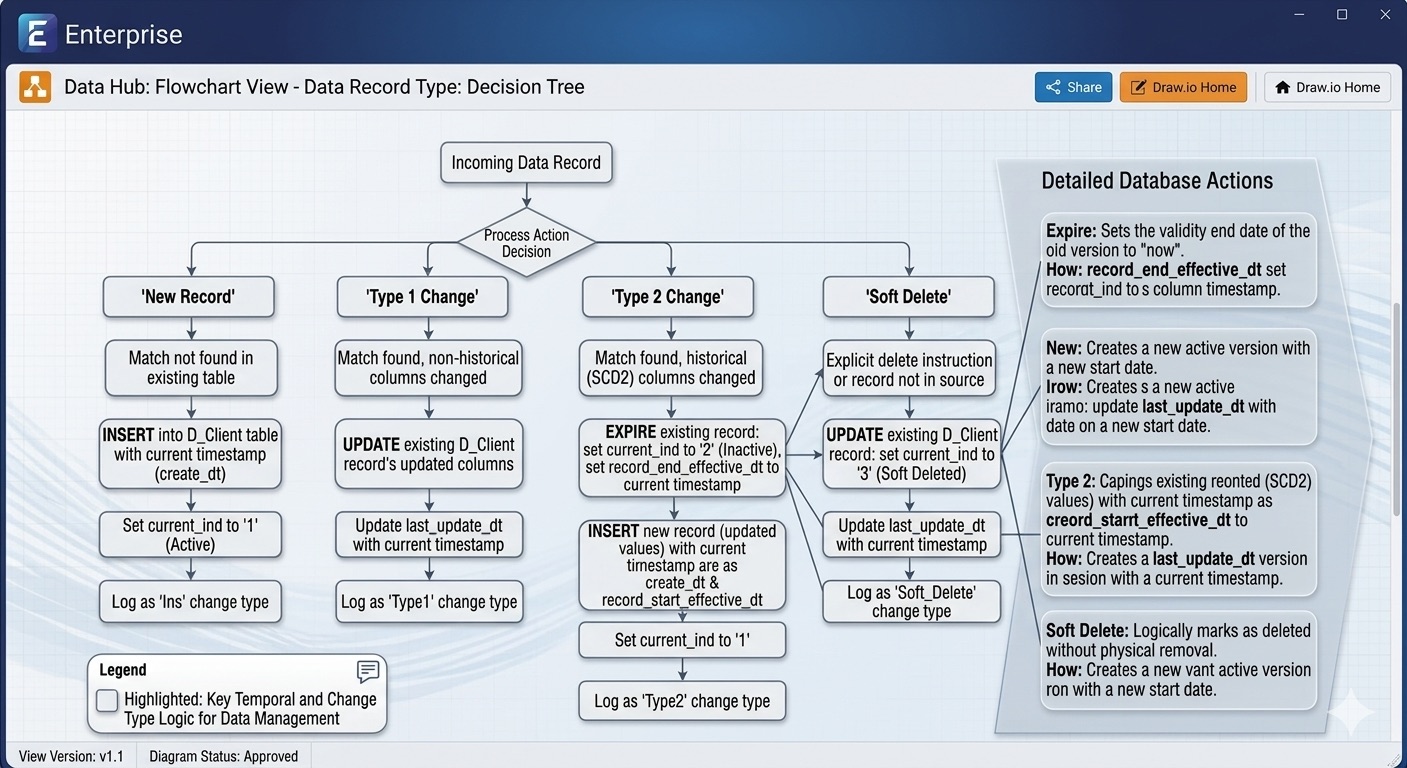
<p><img src="/assets/images/2026/Mar/Type1Typ2_SCD.jpeg" alt="Alt Text: Flowchart detailing the decision logic for handling new records, Type 1 changes, Type 2 changes, and soft deletes in a dimension table." class="align-center" /></p>

<h2 id="the-core-philosophy-what-needs-to-be-tracked">The Core Philosophy: What Needs to be Tracked?</h2>

<p>At its simplest, SCD logic is about defining exactly what changes need to be tracked in a table given the business keys for a given entity. Not all data is created equal, and treating every minor update as a historical event will bloat your data warehouse and destroy query performance.</p>

<p>We typically divide these changes into two categories:</p>

<h3 id="type-1-the-overwrite-non-business-critical">Type 1: The “Overwrite” (Non-Business Critical)</h3>

<p>Type 1 changes are used when we do not need to preserve the history of a specific attribute. This is typically reserved for corrections to data entry errors or changes to non-business-critical fields.</p>

<p>Example: A customer’s first name was entered as “Jonh” instead of “John”. We do not need a historical record showing that we once thought his name was Jonh. We simply overwrite the record with the correct spelling.</p>

<h3 id="type-2-the-historical-track-business-critical">Type 2: The “Historical Track” (Business Critical)</h3>

<p>Type 2 changes are the lifeblood of accurate point-in-time reporting. When a business-critical attribute changes, we must preserve the old record and create a new one to reflect the current state.</p>

<p>Example: A customer changes their street address. If they place an order today, we need to know their current address. But if we run a regional sales report for 2022, that order must be tied to their old address. Type 2 logic ensures both realities exist simultaneously in the database.</p>

<h2 id="the-anatomy-of-an-scd-table">The Anatomy of an SCD Table</h2>

<p>To manage this time-traveling act, we cannot rely solely on the data provided by the source system. We must inject our own architectural metadata into the dimension tables. For every table tracking Type 2 history, I mandate the inclusion of the following control columns:</p>

<p>record_start_effective_dt: The timestamp when this specific version of the record became active.</p>

<p>record_end_effective_dt: The timestamp when this specific version of the record ceased to be active.</p>

<p>current_ind: A quick-reference indicator (usually an integer) to flag the currently active record.</p>

<p>last_update_dt: The timestamp of the most recent modification to the row (crucial for tracking Type 1 updates on a Type 2 row).</p>

<p>create_dt: The exact timestamp the row was physically inserted into our database.</p>

<p>rec_type_cd: A custom record type code I always add to help classify the nature of the row or the ingestion pattern that created it.</p>

<h2 id="executing-the-logic-at-scale">Executing the Logic at Scale</h2>

<p>When a new file or stream arrives from the source system, the ETL/ELT engine (whether that is PySpark on Databricks, Azure Data Factory, or dbt on Redshift) must compare the incoming business keys against the target table.</p>

<h3 id="initializing-the-first-record">Initializing the First Record</h3>

<p>When a brand new business key appears, we insert it. But what do we use for the record_start_effective_dt?</p>

<p>While it is tempting to use the record creation date from the source system (if viable), my experience has shown this can be dangerous. With older legacy systems, changes at the source often do not occur in the expected chronological order. Late-arriving data can wreak havoc on your timelines.</p>

<p>Because of this, I prefer to initialize the very first record of a new entity with a default start date of 1900-01-01. This approach acts as a catch-all, ensuring we always have a valid value for the record backward through time, preventing outer-join failures in our BI layer when dealing with historical fact records that might pre-date the source system’s creation timestamp.</p>

<p>The record_end_effective_dt for this active record is set to the maximum viable date, typically 9999-12-30.</p>

<h3 id="handling-a-type-1-change">Handling a Type 1 Change</h3>

<p>If the incoming data shows a change only to a Type 1 attribute (e.g., the first name correction), the engine performs a simple update. We overwrite the first name field and update our last_update_dt to CURRENT_TIMESTAMP. The start and end effective dates remain completely untouched.</p>

<h3 id="handling-a-type-2-change">Handling a Type 2 Change</h3>

<p>If the incoming data shows a change to a Type 2 attribute (e.g., the street address), the engine must perform a precise surgical operation:</p>

<p>Expire the Existing Record: We take the currently active record (where record_end_effective_dt is 9999-12-30) and update its end date to the exact time the change occurred in the source system. The Architect’s Secret: To prevent overlapping timelines and ensure that a “BETWEEN” SQL query doesn’t accidentally pull two records for the exact same millisecond, I apply a slight offset to the expiration date. Typically, I subtract 0.0001 nanoseconds (NS) from the change date.</p>

<p>Insert the New Record: We insert the new row with the updated address. The record_start_effective_dt is set to the exact time the change occurred in the source system, and the record_end_effective_dt is set to 9999-12-30.</p>

<p>Update Indicators: The old record’s current_ind is flipped to indicate it is historical, and the new record’s current_ind is set to active.</p>

<h2 id="real-world-gotchas-and-edge-cases">Real-World “Gotchas” and Edge Cases</h2>

<p>In a perfect world, the logic above runs flawlessly. However, in enterprise environments, the world is rarely perfect. Here are two massive edge cases you must architect for:</p>

<h3 id="1-the-time-zone-consideration">1. The Time Zone Consideration</h3>

<p>Data does not respect geography. If your source system is a legacy application running in the Toronto time zone (EST/EDT) but your target data warehouse is configured to UTC, a change that happens at 10:00 PM in Toronto actually happens at 2:00 AM the next day in UTC.</p>

<p>If you do not explicitly handle time zone conversions during your SCD processing, your record_start_effective_dt will drift, leading to mismatched joins with fact tables. Special considerations and explicit casting to UTC must be handled at the ingestion layer before the SCD merge logic ever fires.</p>

<h3 id="2-handling-deletes-at-source-via-soft-deletes">2. Handling Deletes at Source via Soft Deletes</h3>

<p>What happens when a record is deleted in the source system? Hard deleting data in a data warehouse is generally an architectural sin. We need to preserve the history, but ensure the BI layer knows the entity no longer exists in the operational system.</p>

<p>I typically handle soft deletes using one of two methods, depending on the constraints of the consumption layer:</p>

<ul>
  <li>
    <p>The Multi-State Flag: I use the current_flag as a small integer to track state. 1 means the record is current and active. 2 means the record is a historical (past) Type 2 version. 3 means the record has been soft-deleted at the source.</p>
  </li>
  <li>
    <p>The Explicit Indicator: Alternatively, if the reporting layer requires simpler boolean logic, I will add a dedicated deleted_ind column. In this scenario, when a delete is detected, the current_ind remains 1 (because it is technically the most current state of that record), but the deleted_ind is set to true.</p>
  </li>
</ul>

<h2 id="conclusion">Conclusion</h2>

<p>Data modeling is not just about drawing boxes and lines; it is about writing the rules of reality for your organization’s history. By implementing rigorous, defensively designed SCD Type 1 and Type 2 logic—accounting for microsecond overlaps, time zone drifts, and soft deletes—you build a foundation that analysts and data scientists can actually trust.</p>

<p>In the next post, I will be breaking down how these dimension tables interact with massive, 200-million-row fact tables, and the architectural decisions behind designing highly performant Star Schemas.</p>]]></content><author><name>main_author</name></author><category term="insights-blog" /><category term="SCD" /><category term="Slowly Changing Dimensions" /><category term="Data Warehousing" /><category term="Databricks" /><category term="Redshift" /><category term="ETL" /><category term="Data Integrity" /><summary type="html"><![CDATA[Master the art of historical data tracking with Slowly Changing Dimensions (SCD Type 1 & Type 2). Learn battle-tested strategies for architecting scalable and performant SCD solutions in modern data platforms like Databricks and Redshift, ensuring unshakeable data integrity.]]></summary></entry><entry><title type="html">Azure AI in Telecommunications: Driving ROI with a Unified, Trusted Platform</title><link href="/insights-blog/azure-ai-pitches/" rel="alternate" type="text/html" title="Azure AI in Telecommunications: Driving ROI with a Unified, Trusted Platform" /><published>2026-03-12T14:00:00+00:00</published><updated>2026-03-12T14:00:00+00:00</updated><id>/insights-blog/azure-ai-pitches</id><content type="html" xml:base="/insights-blog/azure-ai-pitches/"><![CDATA[<h1 id="azure-ai-in-telecommunications-driving-roi-with-a-unified-trusted-platform">Azure AI in Telecommunications: Driving ROI with a Unified, Trusted Platform</h1>

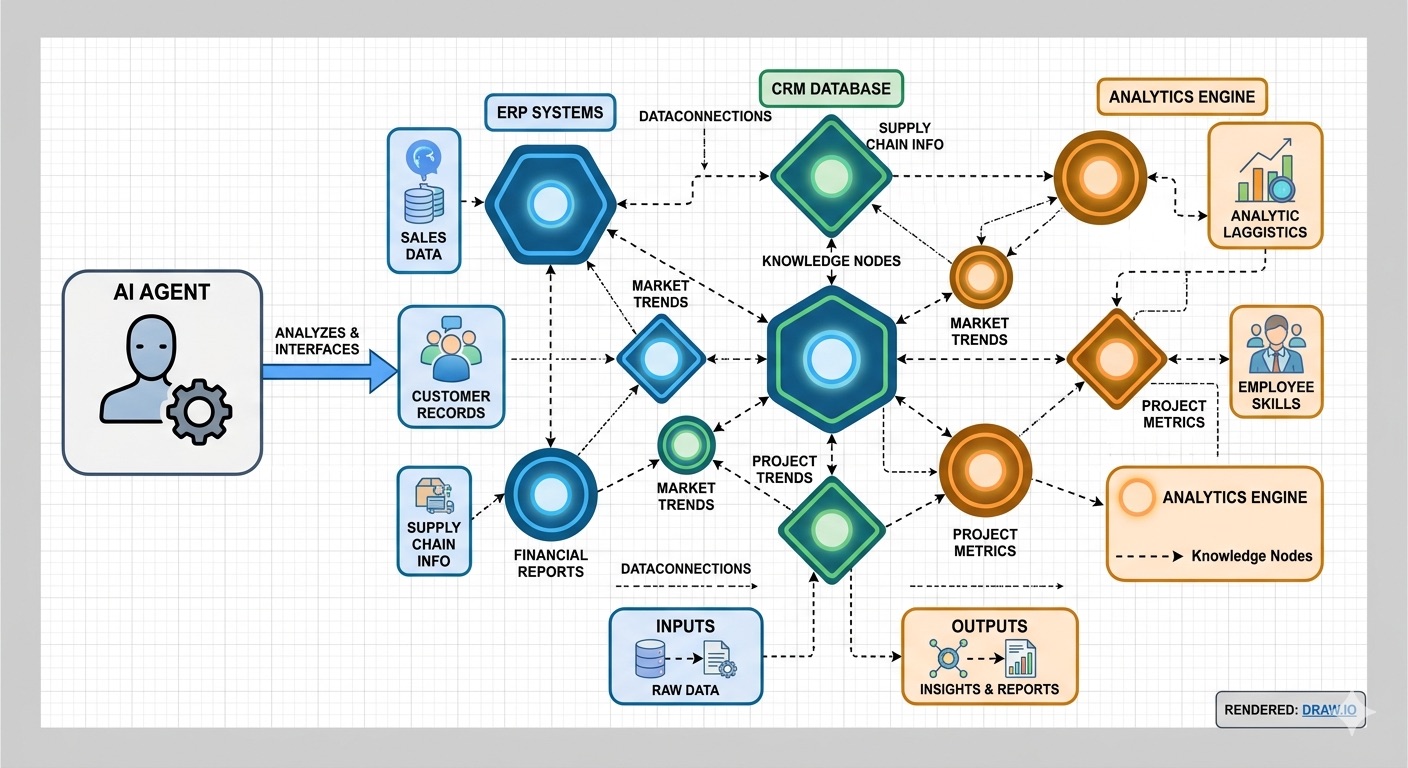
<p><img src="/assets/images/2026/Mar/Databricks-Agent-Bricks-for-Intelligent-Assistance.jpeg" alt="Alt Text: Illustration of Azure AI unifying telecommunications networks for ROI and secure data flow" /></p>

<p>In the rapidly evolving landscape of telecommunications, the imperative for digital transformation is not merely about adopting new technologies; it’s about strategically leveraging them to unlock tangible business value. Microsoft’s latest pronouncements at MWC 2026 underscore a critical pivot: the unification of AI capabilities within a trusted platform, specifically Azure, designed to deliver significant Return on Investment (ROI) for telcos. This is not a speculative vision; it is a meticulously crafted strategy aimed at reshaping how telecommunication companies approach AI, data, and sovereign cloud solutions.</p>

<h2 id="the-strategic-imperative-unifying-for-roi">The Strategic Imperative: Unifying for ROI</h2>

<p>For too long, AI initiatives in the telecom sector have often been fragmented, yielding limited results. Microsoft’s core message at MWC 2026 addresses this directly by advocating for a unified AI platform. The rationale is clear: a cohesive approach accelerates the return on intelligence by streamlining data access and enabling agentic workflows that can operate across disparate systems.</p>

<p>Specifically, the ability to unify data across Operational Support Systems (OSS), Business Support Systems (BSS), telemetry, and broader business systems is paramount. Without this foundational layer of integrated data, even the most sophisticated AI models operate in silos, unable to glean the comprehensive insights necessary for impactful decision-making. Furthermore, the concept of “agentic workflows”—AI systems capable of initiating and executing actions across these integrated systems—is where the real value often lies. These agents move beyond passive analytics to active intervention, automating processes, optimizing networks, and personalizing customer experiences.</p>

<p>However, the power of agentic AI comes with a crucial need: robust operational governance. Maintaining stringent risk, audit, and compliance controls within these highly automated, AI-driven environments is not merely a regulatory obligation; it is a strategic imperative to prevent unintended consequences and ensure the responsible deployment of powerful technologies. Microsoft’s unified platform is engineered with this foundational need in mind, embedding governance as a core component rather than an afterthought.</p>

<h2 id="technical-foundations-a-holistic-architecture-for-telecom">Technical Foundations: A Holistic Architecture for Telecom</h2>

<p>Microsoft’s vision for telecom AI is built on a sophisticated, integrated technological stack. This architecture seamlessly intertwines sovereign cloud capabilities, edge computing, a unified data fabric, and agentic AI, all meticulously tailored for the unique demands of telecommunications operators.</p>

<p>The introduction of <strong>Azure Databricks Lakebase</strong>, slated for general availability in March 2026, marks a significant advancement. This offering provides telecom operators with a managed PostgreSQL environment, engineered with a next-generation separation of storage and compute. This architectural choice is particularly relevant for transactional workloads, allowing for greater scalability, efficiency, and flexibility in handling the massive data volumes inherent in telecom operations. The ability to decouple storage from compute resources means telcos can independently scale these components, optimizing costs and performance based on real-time demands.</p>

<p>Beyond foundational data infrastructure, Microsoft is introducing new AI tools and reference frameworks explicitly designed to facilitate the scaling of agentic AI across critical telecom functions. This includes enhancing customer experiences through intelligent virtual assistants and personalized service delivery, optimizing network operations through predictive maintenance and dynamic resource allocation, and streamlining network management tasks. These frameworks provide a structured approach for telcos to implement and expand their AI footprint, ensuring consistency and accelerating deployment cycles.</p>

<p>The comprehensive nature of this platform, combining AI, data, governance, and sovereign edge capabilities, represents a significant step forward. It moves beyond isolated point solutions to offer a holistic ecosystem where each component works in concert to maximize efficiency and drive innovation.</p>

<h2 id="realizing-ai-roi-the-path-to-measurable-wins">Realizing AI ROI: The Path to Measurable Wins</h2>

<p>While specific detailed case studies from MWC 2026 were not extensively provided, Microsoft’s emphasis on “realizing AI ROI” is a clear signal of their commitment to tangible business outcomes. The implicit message is that AI deployments must translate into measurable wins, and they propose that three conditions are critical for achieving this:</p>

<ol>
  <li><strong>Unified Data Access:</strong> As discussed, a singular, comprehensive view of data across OSS/BSS, telemetry, and business systems is non-negotiable. This eliminates data silos and provides the rich context necessary for effective AI analysis and action.</li>
  <li><strong>Agentic Workflows Across Systems:</strong> AI must be capable of not just analyzing but acting. Workflows that span multiple operational and business systems enable automation, proactive problem-solving, and dynamic optimization, moving beyond mere reporting to tangible operational improvements.</li>
  <li><strong>Operational Governance:</strong> The rigorous application of risk, audit, and compliance controls within AI deployments ensures that innovation proceeds responsibly. This foundational layer of trust and accountability is essential for long-term, sustainable AI adoption, particularly in a regulated industry like telecommunications.</li>
</ol>

<p>These three pillars form a robust framework for telcos to evaluate and implement AI initiatives, ensuring that every investment is directly tied to a quantifiable improvement in efficiency, customer satisfaction, or operational performance.</p>

<h2 id="navigating-challenges-and-embracing-the-future">Navigating Challenges and Embracing the Future</h2>

<p>The path to widespread AI adoption in telecommunications is not without its hurdles. One significant near-term constraint is the availability of infrastructure capable of supporting these advanced AI workloads. However, Microsoft is aggressively addressing this by scaling its Azure infrastructure while maintaining a sharp focus on optimizing ROI per watt and per token, ensuring that the growth is both robust and economically viable.</p>

<p>The challenge of ensuring operational governance in agentic AI deployments remains paramount. As AI systems take on more active roles, the complexity of maintaining risk, audit, and compliance controls escalates. Microsoft’s unified platform directly addresses this by integrating governance tools and frameworks, providing telcos with the means to manage these complexities effectively.</p>

<p>Furthermore, the need for sovereign cloud and disconnected operations is a critical consideration for many telcos, driven by data residency requirements, security mandates, and evolving regulatory landscapes. Solutions like Azure Local disconnected operations, Microsoft 365 Local, and Foundry Local—designed for large-model inferencing within customer boundaries—highlight Microsoft’s commitment to enabling telcos to meet these stringent requirements without compromising on AI capabilities.</p>

<p>Looking ahead, Microsoft’s strategy is clear: continued expansion of AI capacity and deepening of ecosystem advantages through strategic partnerships with OpenAI, the development of first-party Copilots, and robust agent frameworks. This ongoing innovation is set to further reshape telecom infrastructure, accelerating digital transformation, and solidifying the link between AI deployments and clear business value.</p>

<p>The future of telecommunications, as envisioned by Microsoft, is one where AI is not just a technological add-on but an intrinsic component of a unified, trusted, and intelligently governed operational fabric. The emphasis on ROI and measurable wins suggests a pragmatic yet ambitious trajectory, where AI delivers concrete advantages, driving efficiency, enhancing customer experiences, and ultimately securing a competitive edge in a dynamic global market. The time for telcos to embrace this unified AI approach is now, to unlock the full potential of their data and operations.</p>]]></content><author><name>main_author</name></author><category term="insights-blog" /><category term="azure" /><category term="ai" /><category term="telecommunications" /><category term="roi" /><category term="unified platform" /><category term="agentic ai" /><category term="sovereign cloud" /><category term="mwc 2026" /><summary type="html"><![CDATA[Discover how Microsoft Azure AI is transforming telecommunications by driving significant ROI through a unified, trusted platform, agentic AI, and sovereign cloud solutions discussed at MWC 2026.]]></summary></entry><entry><title type="html">Azure Databricks Lakebase: Unifying Operational Data with the Lakehouse</title><link href="/insights-blog/azure-databricks-lakebase/" rel="alternate" type="text/html" title="Azure Databricks Lakebase: Unifying Operational Data with the Lakehouse" /><published>2026-03-12T14:00:00+00:00</published><updated>2026-03-12T14:00:00+00:00</updated><id>/insights-blog/azure-databricks-lakebase</id><content type="html" xml:base="/insights-blog/azure-databricks-lakebase/"><![CDATA[<h1 id="azure-databricks-lakebase-unifying-operational-data-with-the-lakehouse">Azure Databricks Lakebase: Unifying Operational Data with the Lakehouse</h1>

<p><img src="/assets/images/2026/Mar/EngineeringLed-Architect-PerformanceOptimization.jpeg" alt="Alt Text: Conceptual illustration of Azure Databricks Lakebase unifying transactional and analytical data in a Lakehouse architecture" /></p>

<p>The modern enterprise data landscape is increasingly complex, often characterized by a dichotomy between transactional databases and analytical data lakes. This separation, while historically necessary, has led to significant challenges: data silos, redundant data movement, and the inherent latency in deriving insights from operational activities. Azure Databricks’ introduction of <strong>Lakebase</strong> represents a pivotal innovation designed to collapse this architectural divide, offering a managed, serverless PostgreSQL service specifically engineered for operational data within the unified Lakehouse paradigm. This evolution is not merely incremental; it redefines how organizations can leverage their most critical asset—data—for real-time operations, analytics, and AI.</p>

<h2 id="a-new-era-of-database-architecture-the-strategic-context-of-lakebase">A New Era of Database Architecture: The Strategic Context of Lakebase</h2>

<p>Lakebase is more than just a new database; it’s a strategic enabler for enterprises striving to achieve true data unification. Its core value proposition lies in its ability to converge operational, analytical, and AI workloads onto a single, trusted platform. Traditionally, operational data residing in OLTP databases would need to be extracted, transformed, and loaded (ETL) into a data lake or warehouse for analytical purposes. This process introduces latency, increases complexity, and often leads to data duplication, escalating both cost and governance challenges.</p>

<p>By simplifying data ingestion directly to lakehouse storage on Azure, Lakebase dramatically reduces the need for complex ETL pipelines. This streamlined approach minimizes data movement, ensuring that operational data is immediately available for analytical queries and AI model training without the delays and inconsistencies introduced by traditional architectures. For businesses, this translates into faster time-to-insight, more agile decision-making, and the ability to build and deploy AI applications that are always operating on the freshest data.</p>

<p>The implications extend across various business functions. Lakebase is designed to power critical transactional applications, from order processing systems requiring ACID (Atomicity, Consistency, Isolation, Durability) guarantees to storing the complex states of AI agents. Its reliability and performance are tailored for production environments, making it a robust foundation for any data-intensive operational workload. This integrated approach supports a broader industry shift towards platforms that not only store data but also accelerate data-driven initiatives and the rapid development of cutting-edge AI solutions.</p>

<h2 id="engineering-excellence-decoupled-architecture-and-serverless-agility">Engineering Excellence: Decoupled Architecture and Serverless Agility</h2>

<p>At the heart of Azure Databricks Lakebase’s technical prowess is its innovative decoupled compute and storage architecture. This design principle, a hallmark of modern cloud-native systems, allows for unparalleled flexibility and efficiency. Operational data can be written directly to lakehouse storage on Azure, meaning the underlying data format and location are consistent with the broader analytical ecosystem. This eliminates the impedance mismatch often seen when trying to bridge traditional OLTP databases with data lakes.</p>

<p>Lakebase provides elastic, serverless PostgreSQL compute, a feature that profoundly impacts resource utilization and cost optimization. The compute resources scale instantly with demand, ensuring high performance during peak operational periods, and gracefully scale down to zero when idle. This serverless model eliminates the overhead of provisioning and managing servers, allowing developers and data teams to concentrate on application logic and data utilization rather than infrastructure management. The result is a highly efficient, pay-as-you-go model that aligns resource consumption directly with actual workload needs.</p>

<p>Crucially, Lakebase extends ACID transaction guarantees to operational workloads within the lakehouse environment. This ensures data integrity and consistency, which are non-negotiable for critical business operations. The seamless integration with the broader Databricks Lakehouse Platform means that data stored in Lakebase can be readily accessed and combined with other data assets for comprehensive data management, advanced analytics, and machine learning initiatives. The managed nature of Lakebase further abstracts away the complexities of infrastructure, providing a developer-friendly experience that accelerates time-to-market for new applications.</p>

<h2 id="unlocking-real-world-impact-use-cases-and-advantages">Unlocking Real-World Impact: Use Cases and Advantages</h2>

<p>As a generally available service, Lakebase is ready for production use, indicating its maturity and stability for enterprise adoption. While specific detailed customer case studies are not extensively highlighted in the initial announcements, the design principles and capabilities of Lakebase point to a wide array of real-world applications where it can deliver significant value.</p>

<p>For instance, consider its utility in powering transactional applications that benefit from the rich analytical context of a data lake. An e-commerce platform could use Lakebase to manage real-time order processing, inventory updates, and customer profiles, while simultaneously leveraging the lakehouse for sophisticated recommendation engines and fraud detection systems. The ability to store AI agent states directly within Lakebase is particularly pertinent for emerging AI-driven applications, providing a reliable and performant operational database for managing the dynamic data generated by intelligent agents.</p>

<p>Lakebase directly addresses the traditional complexity and data silos that arise from separating transactional databases from analytical data lakes. By collapsing these two distinct architectural patterns, it mitigates the challenges associated with data movement, duplication, and ensuring data consistency across disparate systems. The native support for ACID properties within a distributed lakehouse environment is a significant advantage, simplifying the architectural design and reducing the operational burden on data teams.</p>

<h2 id="navigating-the-transition-and-future-horizons">Navigating the Transition and Future Horizons</h2>

<p>While the benefits of Lakebase are compelling, enterprises transitioning from existing, often siloed, operational databases will need to consider architectural adjustments and robust migration strategies. This may involve re-evaluating existing application architectures and planning for data migration to leverage the full capabilities of a lakehouse-native transactional service.</p>

<p>Ensuring predictable performance and uptime for critical production applications within a serverless, decoupled architecture is always a design consideration. Lakebase aims to deliver this through its inherent scalability and managed service guarantees, abstracting away much of the underlying complexity for the end-user. However, thorough testing and performance tuning will remain essential for mission-critical deployments.</p>

<p>The general availability of Lakebase marks a significant stride towards the convergence of transactional and analytical workloads within the lakehouse paradigm. Future developments are likely to focus on further enhancing its capabilities for high-performance operational workloads, deepening its integration with advanced AI services, and potentially expanding its support for various data types and query patterns. The concept of a “Lakebase” database architecture is poised to evolve rapidly, with an emphasis on further reducing data movement and duplication across the enterprise data landscape.</p>

<p>Ultimately, Lakebase will play a crucial role in enabling the next generation of real-time, data-intensive applications and accelerating the development of sophisticated AI solutions that can operate directly on top of the lakehouse. For organizations looking to simplify their data architecture, enhance operational agility, and unlock the full potential of their data for both transactional and analytical insights, Azure Databricks Lakebase offers a compelling and transformative solution.</p>]]></content><author><name>main_author</name></author><category term="insights-blog" /><category term="azure" /><category term="databricks" /><category term="lakebase" /><category term="postgresql" /><category term="lakehouse" /><category term="operational data" /><category term="real-time analytics" /><category term="ai" /><category term="serverless" /><summary type="html"><![CDATA[Explore Azure Databricks Lakebase, a managed, serverless PostgreSQL service that unifies operational data with the Lakehouse paradigm, accelerating real-time analytics and AI workloads.]]></summary></entry><entry><title type="html">Databricks Genie Code: Agentic Engineering for Data Work</title><link href="/insights-blog/databricks-genie-code-agentic-engineering/" rel="alternate" type="text/html" title="Databricks Genie Code: Agentic Engineering for Data Work" /><published>2026-03-12T14:00:00+00:00</published><updated>2026-03-12T14:00:00+00:00</updated><id>/insights-blog/databricks-genie-code-agentic-engineering</id><content type="html" xml:base="/insights-blog/databricks-genie-code-agentic-engineering/"><![CDATA[<h1 id="databricks-genie-code-agentic-engineering-for-data-work">Databricks Genie Code: Agentic Engineering for Data Work</h1>

<p><img src="/assets/images/2026/Mar/FoundationForAIDrivenDataStrategies.jpeg" alt="Alt Text: Abstract illustration of Databricks Genie Code (AI agent) streamlining data engineering workflows with Unity Catalog" /></p>

<p>In the ever-accelerating world of data and AI, the demand for timely insights often outpaces the capacity of even the most skilled data engineering teams. The complexities of data ingestion, transformation, quality, and pipeline maintenance present significant bottlenecks, hindering innovation and delaying strategic initiatives. Databricks’ introduction of <strong>Genie Code</strong> heralds a transformative shift towards “agentic engineering,” an approach where autonomous AI agents fundamentally redefine how data work is conceived, executed, and maintained. This innovation is not merely an automation tool; it’s a strategic partner designed to democratize data access, accelerate the data lifecycle, and unlock unprecedented efficiency across the enterprise.</p>

<h2 id="the-dawn-of-agentic-engineering-strategic-implications">The Dawn of Agentic Engineering: Strategic Implications</h2>

<p>Genie Code is positioned as an autonomous AI agent, purpose-built to navigate the intricate landscape of enterprise data. Its core mission is to empower all knowledge workers—from business analysts to data scientists—to interact with their data using natural language, receiving trusted and instant answers. This capability represents a significant leap towards democratizing data access, breaking down the traditional barriers that often exist between business users and the underlying data infrastructure.</p>

<p>By streamlining complex data engineering tasks, from the initial idea conceptualization to full production deployment, Genie Code dramatically accelerates the data lifecycle. This means that valuable insights can be derived and acted upon with unprecedented speed, allowing organizations to respond more agilely to market changes and competitive pressures. For data teams, this translates into a powerful opportunity to shift their focus from repetitive, manual engineering tasks to higher-value strategic initiatives, such as developing novel AI applications or optimizing complex business processes.</p>

<p>Beyond acceleration, Genie Code also promises to enhance the reliability and reduce the operational overhead of data-driven applications. Its ability to proactively maintain and optimize data pipelines and AI models ensures that data quality is consistently high and that systems are performing optimally. This leads to more robust data products and a significant reduction in the reactive effort typically associated with monitoring and troubleshooting data infrastructure.</p>

<h2 id="architectural-brilliance-unity-catalog-as-the-agents-brain">Architectural Brilliance: Unity Catalog as the Agent’s Brain</h2>

<p>At the heart of Genie Code’s technical sophistication is its deep and symbiotic integration with the <strong>Unity Catalog</strong>. This strategic pairing provides Genie Code with an unparalleled, comprehensive understanding of the enterprise’s entire data landscape. Unity Catalog serves as the agent’s brain, offering rich semantic context about tables, columns, data lineage, and, crucially, existing governance policies and access controls. This contextual awareness is fundamental to Genie Code’s ability to operate autonomously and generate trusted, production-ready code.</p>

<p>Genie Code is engineered to generate code that is not only functional but also production-ready, meticulously accounting for environmental differences between staging and production environments. This ensures seamless deployments and reduces the risk of errors in critical pipelines. Furthermore, the agent is adept at building robust workflows for Change Data Capture (CDC), a critical capability for real-time data synchronization, and automatically applying data quality expectations, ensuring data integrity from ingestion to consumption.</p>

<p>One of the most impressive facets of Genie Code is its proactive monitoring and self-correction capabilities. It autonomously monitors Lakeflow pipelines and AI models, triaging failures and investigating anomalies often before human intervention is required. This proactive stance extends to analyzing traces to identify and fix hallucinations in AI models, a common challenge in large language model (LLM) deployments. Moreover, it can autonomously tune resource allocation, optimizing performance and cost for data workloads. This level of autonomy significantly enhances the resilience and efficiency of the entire data and AI platform, freeing up valuable human capital.</p>

<h2 id="real-world-impact-and-emerging-evidence">Real-World Impact and Emerging Evidence</h2>

<p>As a relatively newly launched product, long-term customer case studies with detailed ROI metrics are still emerging. However, the foundational design and capabilities of Genie Code point to immediate and tangible real-world benefits. The emphasis on “streamlining complex data engineering,” “accelerating the data lifecycle,” and “reducing operational overhead” are direct responses to pain points universally experienced by data-driven organizations.</p>

<p>The ability of Genie Code to autonomously “fix hallucinations” in AI models and “tune resource allocation before a human intervenes” represents immediate, measurable improvements in operational efficiency and the reliability of data and AI pipelines. These capabilities translate into reduced downtime, fewer manual interventions, and more accurate AI outputs—all critical for maintaining competitive advantage.</p>

<p>The broader concept of “agentic engineering” is rapidly gaining traction across the industry. This trend underscores a growing market need for autonomous AI solutions that can intelligently manage and optimize data environments, allowing human experts to focus on strategic innovation rather than tactical maintenance.</p>

<h2 id="navigating-challenges-and-forging-the-future">Navigating Challenges and Forging the Future</h2>

<p>While the promise of agentic engineering is immense, its adoption presents certain challenges, primarily centered around trust and integration. Data professionals, accustomed to granular control over their engineering processes, may initially harbor a pragmatic skepticism towards autonomous agents. Databricks addresses this by emphasizing Genie Code’s commitment to “trusted answers” and its ability to enforce “existing governance policies,” leveraging the robust framework provided by Unity Catalog.</p>

<p>Ensuring that the AI agent’s autonomous actions align perfectly with evolving business requirements and complex data governance rules is paramount. Unity Catalog’s deep integration mitigates this by providing the comprehensive context needed for intelligent and compliant operations. Furthermore, the interpretability and explainability of code generated by an autonomous agent will be a key consideration for some organizations, necessitating transparent logging and auditing capabilities within the platform.</p>

<p>Genie Code represents a significant stride towards fully autonomous data engineering. Future enhancements will likely expand its scope of autonomous actions, enabling it to solve an even broader array of data challenges. Deeper integration with other Databricks services and potentially third-party tools will further enhance its ecosystem value, creating a more cohesive and powerful data platform.</p>

<p>The evolution of agentic engineering is poised to lead to more sophisticated AI agents capable of managing entire data and AI lifecycles with minimal human oversight. This continuous refinement will drive greater efficiency and reliability in enterprise data platforms. Ultimately, Genie Code is set to play a crucial role in empowering a broader range of users—including business analysts and domain experts—to directly leverage the power of the Lakehouse Platform, transforming how organizations harness their data for competitive advantage.</p>]]></content><author><name>main_author</name></author><category term="insights-blog" /><category term="databricks" /><category term="genie code" /><category term="agentic engineering" /><category term="ai" /><category term="data engineering" /><category term="unity catalog" /><category term="data lifecycle" /><category term="automation" /><summary type="html"><![CDATA[Discover Databricks Genie Code, an autonomous AI agent enabling 'agentic engineering' for data work. Learn how it streamlines data ingestion, transformation, and pipeline maintenance with Unity Catalog integration.]]></summary></entry><entry><title type="html">An approach to handling Data Quality in ETL Pipelines: Practices and Strategies</title><link href="/insights-blog/databricks-handle-data-quality/" rel="alternate" type="text/html" title="An approach to handling Data Quality in ETL Pipelines: Practices and Strategies" /><published>2026-03-12T14:00:00+00:00</published><updated>2026-03-12T14:00:00+00:00</updated><id>/insights-blog/databricks-handle-data-quality</id><content type="html" xml:base="/insights-blog/databricks-handle-data-quality/"><![CDATA[<h1 id="an-approach-to-handling-data-quality-in-etl-pipelines-practices-and-strategies">An approach to handling Data Quality in ETL Pipelines: Practices and Strategies</h1>

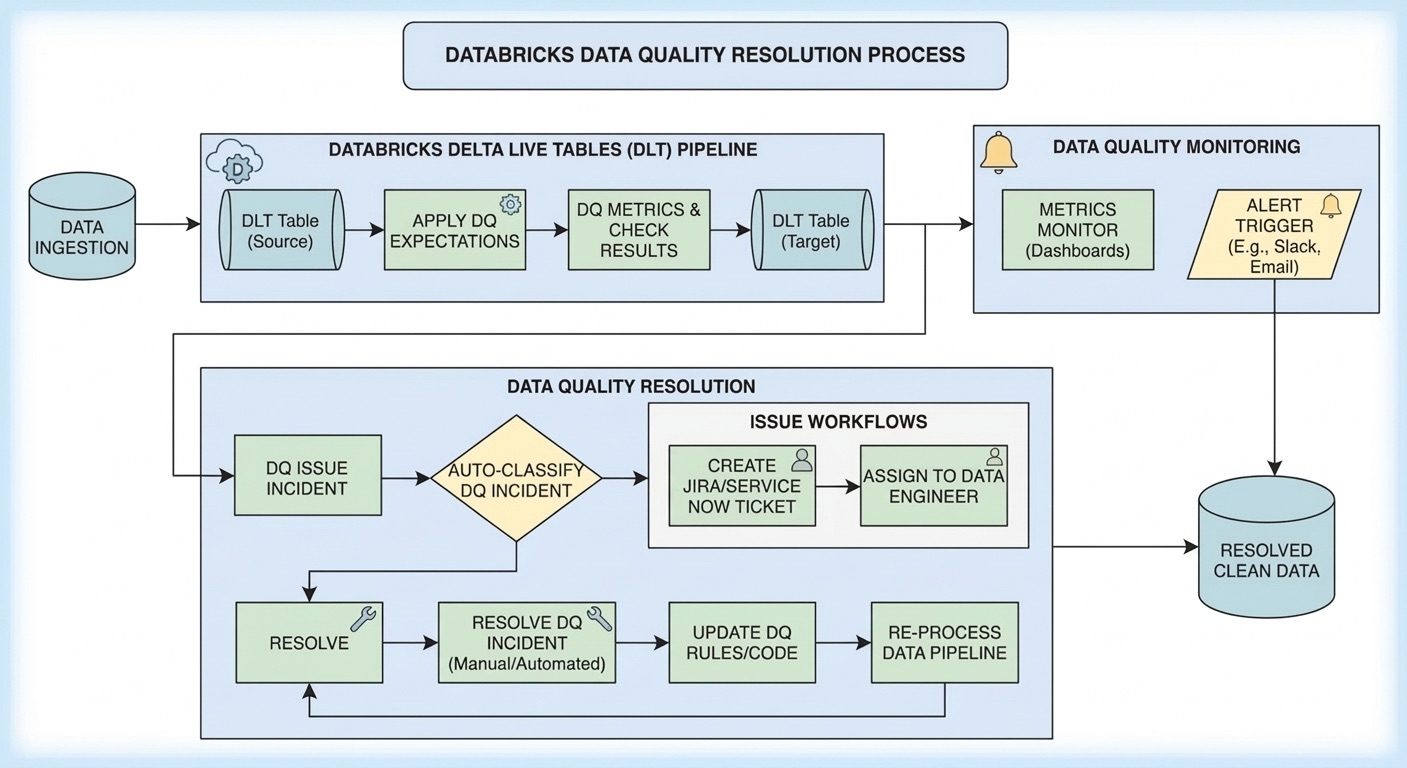
<p>In today’s data-driven world, the success of any initiative hinges on the quality of its data. Accurate, complete, and reliable data is paramount for effective analytics, informed decision-making, and seamless operational processes. This article presents a robust approach to proactively address and resolve common data quality issues, such as invalid city names, missing or incorrect postal codes, and inconsistent field values, directly within modern ETL pipelines. While third-party data quality utilities offer valuable solutions, this guide focuses on implementing an internal, customizable framework that aligns with your organization’s specific guidelines and best practices.</p>

<p><img src="/assets/images/2026/Mar/DatabricksDataQualityResolutionProcess.jpeg" alt="Alt Text: Abstract illustration of data flowing through quality checks and transformations in an ETL pipeline." /></p>

<h2 id="1-utilize-data-profiling-to-identify-issues">1. Utilize Data Profiling to Identify Issues</h2>

<p>Before addressing data quality issues, it’s essential to understand your data. Data profiling helps uncover not only data type and volume, but also patterns, anomalies, and valid value ranges for each field.</p>

<p>The list of valid values can be later used in defining data quality rules.</p>

<h3 id="actions-to-take">Actions to take:</h3>

<ul>
  <li>
    <p>Identify valid values for fields such as city names or postal codes.</p>
  </li>
  <li>
    <p>Detect missing, null, or out-of-range values.</p>
  </li>
  <li>
    <p>Highlight inconsistencies like misspelled categories (e.g., “Mal” instead of “Male”).</p>
  </li>
</ul>

<h2 id="2-define-a-data-quality-translation-rule-mapping-table">2. Define a Data Quality Translation Rule Mapping Table</h2>

<p>Standardizing corrections is crucial for repeatability and transparency. A data quality translation rule mapping table enables this by explicitly documenting transformations.</p>

<h3 id="key-fields-to-include">Key fields to include:</h3>

<ul>
  <li>
    <p>Column Name: The field to correct (e.g., “CITY”).</p>
  </li>
  <li>
    <p>Source Name: Origin of the data. ( e.g. “Customer_Survey”)</p>
  </li>
  <li>
    <p>Source Value: Invalid or inconsistent value (e.g., “toront”).</p>
  </li>
  <li>
    <p>Target Value: Corrected value (e.g., “Toronto”).</p>
  </li>
  <li>
    <p>Create Date: When the rule was defined. (e.g. today())</p>
  </li>
  <li>
    <p>Enabled Flag: Indicates if the rule is active. (e.g. Lit(‘Y’))</p>
  </li>
</ul>

<p>This approach ensures consistent corrections across ETL processes. Deploy this table in your ETL schema or DQ(data quality) schema.</p>

<h2 id="example-creating-a-delta-table-for-data-quality-rules-in-databricks">Example: Creating a Delta Table for Data Quality Rules in Databricks</h2>

<p>To efficiently manage data quality rules, you can store them in a Delta table for versioning, scalability, and query performance. Here’s an example of how to set up a Delta table for this purpose:</p>

<p>Note that this should be stored in a table/csv/json, loaded to a dataframe and cashed for performance; but for examples sake, we will use a simple object.</p>

<h1 id="define-the-schema-for-the-data-quality-rules">Define the schema for the data quality rules</h1>
<p>rules_schema = StructType([
 StructField(“column_name”, StringType(), True),
 StructField(“source_name”, StringType(), True),
 StructField(“source_value”, StringType(), True),
 StructField(“target_value”, StringType(), True),
 StructField(“create_date”, DateType(), True),
 StructField(“enabled_flag”, BooleanType(), True)
])</p>
<h1 id="create-a-sample-dataset-of-data-quality-rules">Create a sample dataset of data quality rules</h1>
<p>rules_data = [
 (“CITY”, “external_source”, “toront”, “Toronto”, “2024-12-01”, True),
 (“CITY”, “external_source”, “toronto”, “Toronto”, “2024-12-01”, True),
]</p>

<h1 id="create-a-dataframe-with-the-sample-data">Create a DataFrame with the sample data</h1>
<p>df_dq_rules = spark.createDataFrame(rules_data, schema=rules_schema)</p>

<h2 id="3-integrate-data-quality-rules-into-etl-processes">3. Integrate Data Quality Rules into ETL Processes</h2>

<p>Incorporate the data quality translation rules as a step in your ETL pipeline. Load original data rows into a staging table and apply corrections in subsequent processing.
Eg. An example to apply translation</p>

<p>def translate_DQ_rule(dfSrc:DataFrame, strSrcColumn:str, dfDQTranslation:DataFrame):
    “””
    Arguments:
        dfSrc (DataFrame): Dataframe containing the data to be transformed.
        strSrcColumn (str): The name of the column in dfSrc to apply translations to.
        dfDQTranslation (DataFrame): Dataframe with translation rules (e.g., source_value to target_value).
    Result:
        DataFrame: A new DataFrame with data quality translations applied to the specified column.
    Sample:
        dfSrc = translate_DQ_rule(dfSrc, “CITY”, dfDQTranslation)
    “””
    ## Apply translation
    return dfSrc</p>
<h3 id="recommended-practice">Recommended practice:</h3>
<p>Apply corrections as Type 2 Slowly Changing Dimensions (SCD) to preserve the original row and track changes. This approach ensures a complete audit trail of both raw and corrected data.</p>

<p>Any data quality transformations should be placed in a separate library file with other user defined functions(UDFs) so that they can be shared with other notebook or projects.</p>

<p>Eg. you can import a library notebook via:</p>

<p>%run ../../libs/nt_library_DataQuality</p>

<h2 id="4-track-data-quality-issues">4. Track Data Quality Issues</h2>

<p>Enhance the ETL process to log every data quality issue detected during loading. Maintain detailed records or generate summary reports showing the number of issues per field.</p>

<h3 id="benefits">Benefits:</h3>

<ul>
  <li>
    <p>Provides transparency into the health of your dataset.</p>
  </li>
  <li>
    <p>Identifies recurring issues that need systemic fixes (e.g., data entry errors).</p>
  </li>
</ul>

<h2 id="5-generate-data-quality-reports">5. Generate Data Quality Reports</h2>

<p>Set up regular reporting on key data quality metrics, including:</p>

<ul>
  <li>
    <p>The number of corrections applied by field.</p>
  </li>
  <li>
    <p>Trends in data quality over time.</p>
  </li>
  <li>
    <p>New or unexpected values in categorical columns.</p>
  </li>
</ul>

<p>These reports empower teams to monitor improvements and address emerging problems.</p>

<h2 id="6-leverage-external-apis-for-advanced-corrections">6. Leverage External APIs for Advanced Corrections</h2>

<p>For fields like addresses, enrich your data with external APIs. For instance, a postal service API can validate and correct addresses based on authoritative databases.</p>

<h3 id="best-practices">Best practices:</h3>

<ul>
  <li>
    <p>Maintain a mapping of API corrections for review and approval to prevent overcorrection.</p>
  </li>
  <li>
    <p>Use APIs selectively for high-value data fields to balance cost and quality.</p>
  </li>
</ul>

<h3 id="example-workflow-for-address-validation">Example Workflow for Address Validation</h3>

<ul>
  <li>
    <p>Original Data: Load raw records into a staging table.</p>
  </li>
  <li>
    <p>Profile Data: Identify invalid or incomplete addresses.</p>
  </li>
  <li>
    <p>Enrich Data: Query the API for potential corrections.</p>
  </li>
  <li>
    <p>Review/Approve: Implement a mechanism for manual review of corrections, if needed.</p>
  </li>
  <li>
    <p>Apply Corrections: Update data as a Type 2 change in the main table.</p>
  </li>
</ul>

<h2 id="conclusion">Conclusion</h2>

<p>Handling data quality issues requires a structured, scalable approach. By leveraging data profiling, rule-based transformations, external APIs, and detailed reporting, organizations can improve the accuracy and reliability of their datasets.With these steps integrated into your ETL pipeline, you’ll be well-equipped to tackle even the most complex data quality challenges, driving better insights and business outcomes.What strategies have you implemented for managing data quality in your pipelines? Share your thoughts below!</p>]]></content><author><name>main_author</name></author><category term="insights-blog" /><category term="data quality" /><category term="ETL" /><category term="databricks" /><category term="data profiling" /><category term="data governance" /><summary type="html"><![CDATA[Discover practical strategies and best practices for managing data quality in ETL pipelines. Learn how to utilize data profiling, implement translation rules, integrate external APIs, and generate reports to ensure accurate and reliable data for your business.]]></summary></entry><entry><title type="html">Databricks Unity Catalog’s Enhanced Data Discovery: Unlocking Business Context and Trust at Scale</title><link href="/insights-blog/databricks-unity-catalog-data-discovery/" rel="alternate" type="text/html" title="Databricks Unity Catalog’s Enhanced Data Discovery: Unlocking Business Context and Trust at Scale" /><published>2026-03-12T14:00:00+00:00</published><updated>2026-03-12T14:00:00+00:00</updated><id>/insights-blog/databricks-unity-catalog-data-discovery</id><content type="html" xml:base="/insights-blog/databricks-unity-catalog-data-discovery/"><![CDATA[<h1 id="databricks-unity-catalogs-enhanced-data-discovery-unlocking-business-context-and-trust-at-scale">Databricks Unity Catalog’s Enhanced Data Discovery: Unlocking Business Context and Trust at Scale</h1>

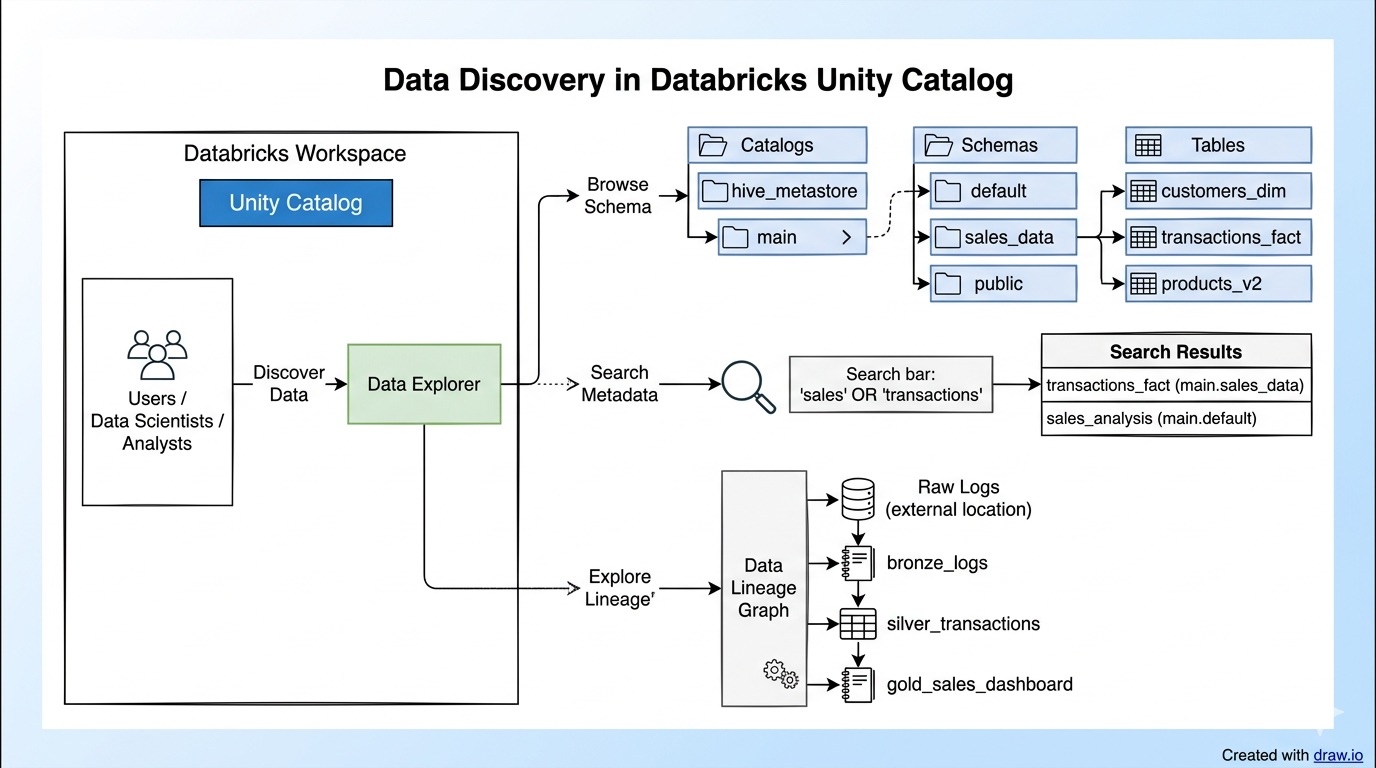
<p><img src="/assets/images/2026/Mar/DataDiscoveryDatabricksUnityCatalog.jpeg" alt="Alt Text: Illustration of Databricks Unity Catalog centralizing and enhancing data discovery with business context and trust" /></p>

<p>In the era of data-driven decision-making, the sheer volume and diversity of enterprise data have become both a tremendous asset and a formidable challenge. Organizations often grapple with “data sprawl,” where valuable data assets are scattered across disparate systems, difficult to find, and lack the essential business context necessary for effective utilization. Databricks has taken a significant leap forward in addressing these challenges with the substantial enhancements to its <strong>Unity Catalog</strong>, introducing a new “Discover” experience meticulously designed to unify data discovery and embed critical business context for enterprises operating at scale. This evolution is transforming how companies access, understand, and govern their data, fostering a culture of trust and accelerating data and AI workflows.</p>

<h2 id="the-strategic-imperative-bridging-the-gap-between-data-and-business-value">The Strategic Imperative: Bridging the Gap Between Data and Business Value</h2>

<p>Historically, the chasm between technical data assets and their strategic business value has been a significant barrier to deriving maximum utility from data investments. Data scientists, analysts, and knowledge workers often spend an inordinate amount of time simply searching for the right data, verifying its accuracy, and deciphering its meaning—time that could be better spent on analysis and innovation. Unity Catalog’s enhanced Discover experience directly confronts this issue by making data assets not just discoverable, but immediately understandable within their business context.</p>

<p>By unifying data discovery, Databricks helps organizations overcome the pervasive problem of data silos. A centralized, intelligent catalog allows users to quickly locate relevant, trusted data assets across the entire organization. This is crucial for improving decision-making, as it ensures that business leaders and technical teams alike are working from a consistent, well-understood data foundation. The integration of business context—such as descriptive tags, usage insights, and AI-powered documentation—bridges the gap between the technical specifications of data and its real-world implications, enabling more informed and impactful business strategies.</p>

<p>Moreover, the enhanced Unity Catalog fosters a more collaborative data environment. When data assets are easily discoverable and their meaning is transparent, various teams can work together more effectively. This shared understanding accelerates data and AI workflows, as the effort spent on data wrangling and validation is significantly reduced. The ultimate goal is clear: to ensure that every user, regardless of their technical proficiency, can quickly find, understand, and utilize high-impact data to drive business outcomes.</p>

<h2 id="architectural-excellence-centralized-trust-and-ai-powered-insights">Architectural Excellence: Centralized Trust and AI-Powered Insights</h2>

<p>The technical architecture underpinning the Databricks Discover experience is deeply integrated into Unity Catalog, leveraging its foundational capabilities for centralized governance, trust, and access control. Unity Catalog acts as the single source of truth for an enterprise’s metadata, offering a comprehensive suite of features including access control, auditing, lineage tracking, quality monitoring, and now, significantly enhanced data discovery across all Databricks workspaces.</p>

<p>One of the standout features is its automatic curation of discovery, which intelligently surfaces trusted and high-impact data assets. This proactive approach minimizes manual effort in cataloging and ensures that users are guided towards the most relevant and reliable data. The integration of AI-powered documentation and usage insights further enriches the context surrounding each data asset. Imagine an AI agent automatically generating clear descriptions for tables, explaining complex column definitions, and even highlighting patterns of how the data is being consumed across the organization. This level of context is invaluable for accelerating onboarding, reducing errors, and promoting efficient data utilization.</p>

<p>Governed business semantics play a critical role in ensuring consistency and trust. By treating business metrics as first-class data assets and introducing a curated internal marketplace, Unity Catalog helps surface standardized, trusted metrics across disparate teams and tools. This eliminates the confusion and inconsistencies that often arise from different departments using varying definitions for key performance indicators (KPIs), thereby ensuring that all stakeholders are speaking the same data language.</p>

<p>Furthermore, Unity Catalog extends its value to knowledge workers by providing a curated internal marketplace for data and AI assets, organized logically by domain. This not only simplifies data sharing but also encourages the reuse of valuable assets, fostering an internal ecosystem of data products. The platform also robustly captures lineage data, meticulously tracking how data assets are created, transformed, and utilized across all programming languages and processes within the Lakehouse. This transparency is crucial for auditing, compliance, and debugging, offering a complete historical view of data flows.</p>

<h2 id="real-world-impact-and-addressing-challenges">Real-World Impact and Addressing Challenges</h2>

<p>While specific granular case studies from the initial announcements may not be widely publicized, the strategic focus of Unity Catalog’s Discover experience directly targets pervasive challenges faced by large enterprises. The sheer volume and diversity of data make effective discovery nearly impossible without a unified, intelligent solution—a problem that Unity Catalog is built to solve. By centralizing discovery, it acts as a GPS for data, guiding users to the precise information they need.</p>

<p>Ensuring data trust and accuracy across numerous, often disparate, data sources is a critical concern for any organization. Unity Catalog mitigates this through its integrated governance framework, robust quality monitoring, and comprehensive lineage tracking capabilities. These features collectively build confidence in the data, empowering users to make decisions based on verifiable information.</p>

<p>Providing relevant business context for technical data assets, which can often be abstract and intimidating, is another significant hurdle. Unity Catalog tackles this by embedding context directly into the discovery process, making complex data immediately more accessible and meaningful to a broader audience. Managing access control and compliance at an enterprise scale for a myriad of data assets is inherently complex. Unity Catalog simplifies this with its centralized governance model and enhanced controls, including features like attribute-based access control, ensuring that data access is secure, compliant, and tailored to individual roles and needs.</p>

<h2 id="future-horizons-intelligence-governance-and-ecosystem-expansion">Future Horizons: Intelligence, Governance, and Ecosystem Expansion</h2>

<p>Databricks’ commitment to continuously extending Unity Catalog underscores its strategic importance. Future developments are set to further enhance governance controls, such as more sophisticated attribute-based access control and advanced data quality monitoring, to scale secure data management across even the largest enterprises. The integration of even more AI-powered capabilities for documentation, insights, and predictive recommendations suggests a future where data discovery becomes even more intelligent, automated, and intuitive.</p>

<p>The ongoing evolution of Unity Catalog reinforces Databricks’ dedication to providing a comprehensive data governance and discovery solution that is seamlessly integrated into the Lakehouse architecture. This continuous innovation ensures that organizations can not only manage their data effectively but also unlock its full potential to drive business growth, accelerate AI initiatives, and maintain a competitive edge in an increasingly data-centric world.</p>]]></content><author><name>main_author</name></author><category term="insights-blog" /><category term="databricks" /><category term="unity catalog" /><category term="data discovery" /><category term="business context" /><category term="data governance" /><category term="ai" /><category term="lakehouse" /><category term="data sprawl" /><summary type="html"><![CDATA[Explore Databricks Unity Catalog's enhanced data discovery features, unifying data access and embedding business context to accelerate data and AI workflows with trust and governance at scale.]]></summary></entry><entry><title type="html">Data Lakehouse Architecture: The Foundation for AI-Driven Data Strategies</title><link href="/insights-blog/delta-lakehouse-architecture/" rel="alternate" type="text/html" title="Data Lakehouse Architecture: The Foundation for AI-Driven Data Strategies" /><published>2026-03-12T14:00:00+00:00</published><updated>2026-03-12T14:00:00+00:00</updated><id>/insights-blog/delta-lakehouse-architecture</id><content type="html" xml:base="/insights-blog/delta-lakehouse-architecture/"><![CDATA[<h1 id="data-lakehouse-architecture-the-foundation-for-ai-driven-data-strategies">Data Lakehouse Architecture: The Foundation for AI-Driven Data Strategies</h1>

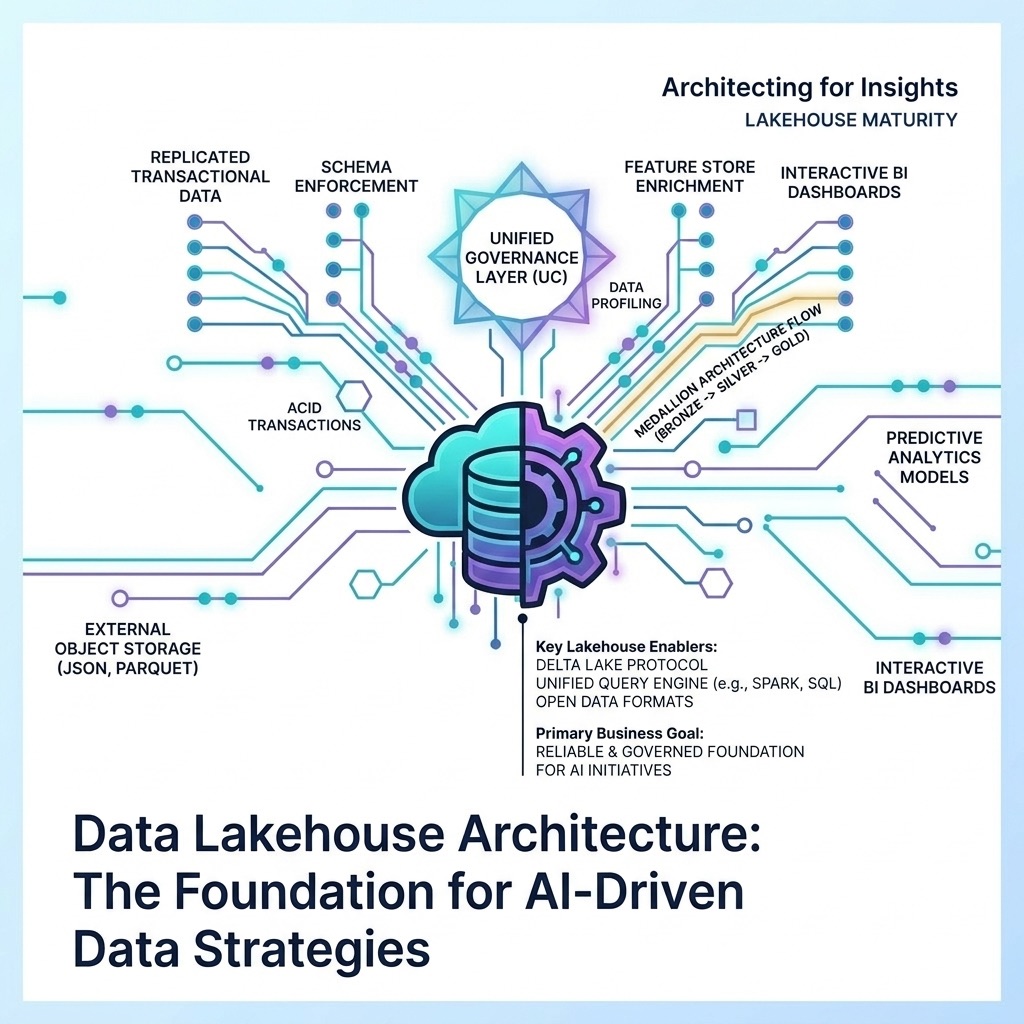
<p><img src="/assets/images/2026/Mar/FoundationForAIDrivenDataStrategies.jpeg" alt="Alt Text: Layered architectural diagram of a Data Lakehouse with cloud object storage, open table formats, and AI/ML integration" /></p>

<p>The landscape of enterprise data management has undergone a profound transformation, moving beyond the traditional dichotomy of data lakes for raw storage and data warehouses for structured analytics. Today, the <strong>Data Lakehouse Architecture</strong> has emerged as the dominant paradigm, offering a unified, flexible, and scalable foundation for AI-driven data strategies. Spearheaded by innovative technologies like Delta Lake and Apache Iceberg, this architecture bridges the best of both worlds, providing ACID (Atomicity, Consistency, Isolation, Durability) transactions on cost-effective object storage, seamlessly integrating with cutting-edge tools like vector databases, and laying the groundwork for exabyte-scale data storage and advanced analytics. This isn’t just an architectural evolution; it’s a strategic imperative for organizations aiming to unlock the full potential of their data in the age of artificial intelligence.</p>

<h2 id="the-strategic-imperative-unifying-data-for-ai-advantage">The Strategic Imperative: Unifying Data for AI Advantage</h2>

<p>For organizations to truly harness the power of AI, they require a data infrastructure that is both robust and adaptable. The data lakehouse architecture fulfills this need by offering a unified approach to data management. It combines the flexibility and vast scalability of data lakes—which are ideal for storing diverse, multi-structured data at a low cost—with the critical data management features traditionally found in data warehouses, such as schema enforcement, data governance, and transactional capabilities.</p>

<p>This convergence is crucial for companies looking to derive advanced insights from their ever-growing and increasingly diverse datasets. It supports a spectrum of workloads, from traditional Business Intelligence (BI) and reporting to the most demanding modern AI and Machine Learning (ML) applications. By providing ACID transactions directly on cloud object storage (like AWS S3, Azure Data Lake Storage (ADLS), or Google Cloud Storage (GCS)), the lakehouse ensures data reliability and consistency. This is a non-negotiable requirement for critical business operations, where data accuracy and integrity directly impact decision-making and regulatory compliance.</p>

<p>Moreover, the integration with vector databases represents a significant leap forward, particularly for advanced AI applications. Vector databases are essential for enabling similarity searches, semantic understanding, and the efficient operation of RAG (Retrieval Augmented Generation) architectures for large language models (LLMs). By bringing these capabilities into the lakehouse ecosystem, organizations can build more sophisticated, context-aware AI applications that can reason over and generate insights from massive, multi-modal datasets, transforming how businesses interact with information.</p>

<h2 id="technical-architecture-a-layered-system-for-scalable-innovation">Technical Architecture: A Layered System for Scalable Innovation</h2>

<p>At its technical core, the data lakehouse architecture is a layered system built upon cloud object storage, providing a cost-effective and highly durable foundation for exabyte-scale data. On top of this storage layer reside open table formats such as <strong>Delta Lake</strong>, <strong>Apache Iceberg</strong>, and <strong>Apache Hudi</strong>. These formats are the unsung heroes of the lakehouse, delivering the crucial capabilities that elevate object storage to a transactional data platform.</p>

<p>These open table formats provide:</p>

<ul>
  <li><strong>ACID Transactions:</strong> Ensuring data integrity and consistency for concurrent read/write operations.</li>
  <li><strong>Schema Evolution:</strong> Allowing data schemas to change over time without breaking existing applications.</li>
  <li><strong>Time Travel:</strong> Enabling users to access and query historical versions of data, crucial for auditing, reproducibility, and recovering from errors.</li>
  <li><strong>Intelligent Pruning:</strong> Optimizing query performance by efficiently filtering data at the file level.</li>
</ul>

<p>These formats meticulously track files and snapshots, providing the transactional guarantees that were once exclusively the domain of expensive, proprietary data warehouses. Delta Lake’s UniForm (Universal Format) further enhances interoperability, allowing Delta tables to be read by clients of other open formats like Iceberg and Hudi. This fosters an open, flexible ecosystem, mitigating vendor lock-in and promoting innovation.</p>

<p>The architecture typically includes a robust ingestion layer designed to handle both batch and streaming data processing, enabling real-time analytics and ensuring that the lakehouse always contains the freshest possible data. A sophisticated catalog layer, often integrated with tools like Databricks Unity Catalog, is essential for centralized governance, metadata management, and the discoverability of data assets across the entire organization.</p>

<p>Finally, a flexible consumption layer serves a diverse array of workloads with consistent semantics. This includes SQL queries for traditional BI tools, interactive dashboards, notebooks for data science and ML experimentation, and direct interfaces for AI agents. The seamless integration with vector databases, such as Pinecone, Milvus, or Weaviate, is becoming a standard pattern for AI applications, enabling efficient similarity search and RAG operations directly within the lakehouse environment.</p>

<h2 id="real-world-adoption-and-overcoming-challenges">Real-World Adoption and Overcoming Challenges</h2>

<p>The widespread adoption and continuous development of open-source projects like Delta Lake, Apache Iceberg, and Apache Hudi—backed by major cloud providers and data companies like Databricks, Snowflake, Google BigQuery, Athena, and Redshift—underscore their proven practical application and success in real-world scenarios. The rapid maturation of these technologies has solidified the data lakehouse as a practical reference architecture, particularly evidenced by its use in petabyte and exabyte-scale implementations across various industries.</p>

<p>However, implementing a data lakehouse architecture is not without its challenges. Managing the complexity of integrating diverse components—from object storage and table formats to ingestion engines, catalogs, compute engines, and vector databases—requires robust orchestration and a clear architectural vision. Ensuring consistent data quality and governance across an evolving, vast data landscape is a continuous effort, addressed by features like schema enforcement, data quality monitoring, and centralized catalogs.</p>

<p>The evolving landscape of open table formats and their interoperability, particularly with innovations like UniForm, aims to mitigate vendor lock-in and foster greater flexibility. While managing multiple formats can introduce a degree of complexity, the benefits of openness and choice often outweigh these concerns. Performance optimization for exabyte-scale queries and demanding AI workloads remains a critical area, requiring careful design and continuous tuning of the entire data stack.</p>

<p>The “layered system” approach of the data lakehouse is poised to become even more modular and adaptable, allowing organizations to tailor their data infrastructure precisely to their evolving business needs and technological advancements. This flexibility, coupled with its inherent scalability and ability to support both traditional analytics and cutting-edge AI, cements the data lakehouse architecture as the indispensable foundation for any truly AI-driven enterprise.</p>]]></content><author><name>main_author</name></author><category term="insights-blog" /><category term="data lakehouse" /><category term="ai" /><category term="data strategies" /><category term="delta lake" /><category term="apache iceberg" /><category term="acid transactions" /><category term="vector database" /><category term="data management" /><summary type="html"><![CDATA[Discover the Data Lakehouse Architecture, unifying data lakes and warehouses for AI-driven strategies. Learn about Delta Lake, Apache Iceberg, ACID transactions, and vector database integration for scalable data management.]]></summary></entry><entry><title type="html">The Engineering-Led Architect: Performance Optimization—Curing Bottlenecks in the Modern Data Lakehouse</title><link href="/insights-blog/engineering-led-architect-performance-optimization/" rel="alternate" type="text/html" title="The Engineering-Led Architect: Performance Optimization—Curing Bottlenecks in the Modern Data Lakehouse" /><published>2026-03-12T14:00:00+00:00</published><updated>2026-03-12T14:00:00+00:00</updated><id>/insights-blog/engineering-led-architect-performance-optimization</id><content type="html" xml:base="/insights-blog/engineering-led-architect-performance-optimization/"><![CDATA[<h1 id="the-engineering-led-architect">The Engineering-Led Architect</h1>

<h2 id="performance-optimizationcuring-bottlenecks-in-the-modern-data-lakehouse">Performance Optimization—Curing Bottlenecks in the Modern Data Lakehouse</h2>

<p>In this series, we have covered the intricacies of historical tracking (SCD logic) and the physical realities of Star Schema design. But what happens when your data models are pristine, your logic is sound, yet your data platform still misses its morning SLAs?</p>

<p>Performance optimization is often misunderstood as purely a coding exercise—adding an index here, tweaking a WHERE clause there. While query optimization is critical, true performance breakthroughs come from an architectural perspective. A Senior Data Architect must be able to identify bottlenecks caused by poor high-level pipeline design just as easily as they can read a Spark execution plan.</p>

<p>Over my 13+ years of enterprise data architecture, I have found that performance issues almost always fall into one of two categories: Macro-Level Flow constraints and Micro-Level Modeling/Query constraints. Here is how I approach solving both.</p>

<h2 id="the-macro-level-fixing-poor-high-level-design">The Macro-Level: Fixing Poor High-Level Design</h2>

<p>Sometimes, the code isn’t the problem; the traffic control is the problem.</p>

<p>I was recently brought in to rescue a massive, 200+ table Medallion architecture load process. The business was failing to meet its 8:00 AM SLA for executive reporting. The Bronze and Silver layers were struggling to process delta records. Because the legacy Oracle source system allowed hard deletes, we couldn’t rely on simple watermark column extracts; entire multi-gigabyte tables (some containing millions of extremely wide records) had to be ingested into Silver for full-table comparisons.</p>

<p>To complicate matters, introducing a Change Data Capture (CDC) tool like Oracle GoldenGate was not an option due to legacy infrastructure constraints.</p>

<h3 id="identifying-the-true-bottleneck">Identifying the True Bottleneck</h3>

<p>When I audited the process, I didn’t immediately rewrite their SQL. I looked at the orchestration.</p>

<p>The pipeline was designed synchronously. Due to integration server constraints, they were extracting five tables at a time. The orchestrator would extract five tables from Oracle to Bronze, and then immediately trigger the Silver layer transformations on Databricks for those five tables.</p>

<p>The fatal flaw: The orchestrator waited for the Databricks Silver load to finish before extracting the next five tables.</p>

<p>The integration server (the bottleneck) sat completely idle while Databricks (a highly scalable distributed compute engine) did the Silver processing. They were starving their own pipeline.</p>

<h3 id="the-architectural-fix-decoupling-the-flow">The Architectural Fix: Decoupling the Flow</h3>

<p>I remodeled the orchestration without changing a single line of underlying transformation code or altering the physical data models.</p>

<p>I implemented an asynchronous, decoupled queue pattern. The integration server’s only job was to continuously extract five tables at a time. As soon as one table finished extracting to Bronze, it immediately handed a token off to a Databricks workflow waiting in the cloud, and the integration server instantly grabbed the next table in the queue to extract.</p>

<p>At all times, the integration server was running at 100% capacity (five active extracts), while Databricks effortlessly scaled its clusters to handle the incoming Silver transformations in parallel.</p>

<p>The Result: The entire Bronze/Silver load process plummeted from an agonizing 6 to 8 hours daily down to just 1.5 to 2.5 hours. No table optimization, no code changes, no underlying architecture overhauls—just a fundamental correction of the high-level data flow.</p>

<h2 id="the-micro-level-data-modeling-and-query-optimization">The Micro-Level: Data Modeling and Query Optimization</h2>

<p>Once the macro-level flow is decoupled and humming, you can turn your attention to the Gold layer, where data modeling and query execution plans dictate performance.</p>

<p>In that same project, the Gold layer processing was taking 3.5 to 4 hours on its own. While the pipeline orchestration was fixed, the actual Spark compute was thrashing. I implemented several targeted optimizations to bring that time down to roughly 2 hours.</p>

<h3 id="eradicating-redundant-merge-statements">Eradicating Redundant MERGE Statements</h3>

<p>In a Delta Lake/Databricks environment, MERGE statements are powerful but computationally expensive because they require scanning the target table, rewriting files, and updating the transaction log.</p>

<p>I found processes that were executing multiple MERGE statements against the same target table within a single run (e.g., merging new inserts, then running a separate merge to update SCD Type 2 expirations). I refactored these into single, unified MERGE operations utilizing complex WHEN MATCHED and WHEN NOT MATCHED clauses. Halving the number of target table scans yielded massive I/O savings.</p>

<h3 id="strategic-caching-and-dag-optimization">Strategic Caching and DAG Optimization</h3>

<p>In complex Gold layer transformations, intermediate datasets are often referenced multiple times (e.g., joining a staging table to three different dimension tables). I optimized the Spark Directed Acyclic Graphs (DAGs) by strategically injecting df.cache() for DataFrames that were reused across multiple downstream actions. This prevented the cluster from recalculating the source extraction and initial transformations multiple times.</p>

<p>Furthermore, I migrated their legacy, disjointed job triggers into unified Databricks Workflows. By enforcing proper task dependencies within a single Workflow DAG, we eliminated cluster start-up overhead and allowed Databricks to intelligently share compute resources across tasks.</p>

<h3 id="partitioning-and-z-ordering">Partitioning and Z-Ordering</h3>

<p>As I discussed in my previous post on Star Schemas, a model that looks perfect on paper can fail in production if the physical layout on disk is ignored.</p>

<p>For the largest Fact tables, query optimization requires aggressive partition pruning. However, over-partitioning can lead to the “small file problem” in cloud storage. We established a strict partitioning strategy based on the Month_ID, ensuring file sizes remained optimal. For high-cardinality columns frequently used in WHERE clauses by the BI layer (like Client_ID), we implemented Z-Ordering (multi-dimensional clustering) on the Delta tables. This allowed the Databricks engine to skip massive amounts of irrelevant data files during query execution, directly accelerating the final reporting dashboards.</p>

<h2 id="conclusion">Conclusion:</h2>
<p>The Holistic View\n\nOptimizing a modern data platform is a balancing act. If your Gold layer models are bloated with redundant strings, your queries will crawl. If your MERGE statements are poorly written, your clusters will burn unnecessary compute credits. But even with perfect code and perfect models, a synchronous, poorly designed ingestion pipeline will cause you to miss your SLAs.\n\nA successful Data Architect doesn’t just write SQL; they design the entire ecosystem. They ensure the data flows smoothly from the source, lands cleanly in the Lakehouse, and is modeled aggressively for the exact realities of the consumption layer. By optimizing both the macro-flow and the micro-code, we ultimately gave the business its data back before 8:00 AM every single day.</p>]]></content><author><name>main_author</name></author><category term="insights-blog" /><category term="Data Lakehouse" /><category term="Performance Optimization" /><category term="Spark" /><category term="Delta Lake" /><category term="ETL" /><category term="Data Architecture" /><category term="Z-Ordering" /><category term="Partitioning" /><summary type="html"><![CDATA[Master data lakehouse performance optimization. Learn how engineering-led architects cure bottlenecks through macro-level pipeline design and micro-level Spark, Delta Lake, partitioning, and Z-Ordering strategies for scalable and efficient data platforms.]]></summary></entry><entry><title type="html">Star Schema Design—Fact, Dimension, and Grain Decisions at Scale</title><link href="/insights-blog/star-schema-design/" rel="alternate" type="text/html" title="Star Schema Design—Fact, Dimension, and Grain Decisions at Scale" /><published>2026-03-12T14:00:00+00:00</published><updated>2026-03-12T14:00:00+00:00</updated><id>/insights-blog/star-schema-design</id><content type="html" xml:base="/insights-blog/star-schema-design/"><![CDATA[<h1 id="star-schema-designfact-dimension-and-grain-decisions-at-scale">Star Schema Design—Fact, Dimension, and Grain Decisions at Scale</h1>

<p>In my previous post, we tackled the complexities of historical tracking using SCD Type 1 and Type 2 logic. But managing history is only half the battle. Once your data is clean and historically accurate, how do you structure it so that a BI dashboard can query 200 million records without timing out?</p>

<p>The answer lies in the architectural bedrock of the modern data warehouse: The Star Schema.</p>

<p>Over the last 13 years, I’ve architected data platforms across government, banking, and pension sectors. I have seen every flavor of data modeling, and I can tell you this: the industry has matured, tools have evolved (hello, Spark and distributed compute), but the fundamental rules of physical data modeling remain the ultimate bottleneck for performance.</p>

<p>Here is my playbook for designing dimension and fact tables that actually perform in the real world.</p>

<p><img src="/assets/images/2026/Mar/StarSchemaDesign.jpeg" alt="Alt Text: A clear, modern illustration of a Star Schema with a central fact table and radiating dimension tables, emphasizing the connections." /></p>

<h2 id="dimensions-keep-it-flat-avoid-the-snowflake">Dimensions: Keep it Flat, Avoid the Snowflake</h2>

<p>When designing dimensions, my rule is simple: I strongly prefer a Star Schema over a Snowflake Schema. I actively avoid building dimensions off of dimensions. Every additional join you introduce into a query path degrades performance, especially in distributed cloud architectures.</p>

<p>A properly designed dimension table must contain three core elements:</p>

<p>The Primary Key (PK): A surrogate key (e.g., D_Client_Key) generated by the data warehouse. This is a meaningless integer used exclusively for joining to the fact table.</p>

<p>The Business Key (BK): The natural key from the source system (e.g., Client_ID). This defines the unique record within the dimension and drives your SCD logic.</p>

<p>The Attributes: The descriptive fields associated with that Business Key (e.g., Client_Name, Gender, Birth_Date).</p>

<h3 id="the-multiple-address-snowflake-dilemma">The “Multiple Address” Snowflake Dilemma</h3>

<p>While I avoid snowflaking, data modeling requires pragmatism. What happens when a client has multiple addresses (e.g., a Home Address and a Billing Address)?</p>

<p>Some architects will normalize this by creating a D_Address table and snowflaking it off the D_Client table via Foreign Keys (FKs). If the address dimension is very small, this might be acceptable. However, I generally advocate for linking addresses directly to the Fact table.</p>

<p>If we are processing a Billing Fact, the Billing_Address_Key belongs directly on that fact record. Even if that address data is technically duplicated as an attribute within the D_Client table, placing the key on the fact table is superior. It ensures that any measures or mapping attributes tied specifically to that billing event are captured at the correct grain, without forcing the reporting engine to traverse through the client dimension to find where the bill was sent.</p>

<h2 id="facts-defining-the-grain-and-enforcing-purity">Facts: Defining the Grain and Enforcing Purity</h2>

<p>The Fact table is the numerical engine of your data model. It should consist entirely of Foreign Keys (pointing to your dimension tables) and Measures (the quantifiable metrics of the business event).</p>

<h3 id="the-golden-rule-no-strings-allowed">The Golden Rule: No Strings Allowed</h3>

<p>Avoid having strings, descriptive text, or categorical attributes within the fact table. Those belong in a dimension. If you find a Transaction_Type_Name varchar column in your fact table, your model is leaking. Move it to a dimension, replace it with a Transaction_Type_Key integer, and watch your storage footprint shrink and your scan speeds soar.</p>

<h3 id="defining-the-grain">Defining the Grain</h3>

<p>The most critical decision in fact table design is defining its grain—what exactly does one single row represent? The grain is driven by the Fact’s Business Key. Is one row a single item on a receipt? Is it the entire receipt? Is it a daily snapshot of an account balance? If you do not explicitly define and document the grain of the fact, you will inevitably end up with double-counting errors in your BI layer.</p>

<h2 id="scale-and-performance-partitioning-the-details">Scale and Performance: Partitioning the Details</h2>

<p>When dealing with massive datasets—such as 200+ million row fact tables—a pristine Star Schema is not enough on its own. You must engineer for the physical realities of data retrieval.</p>

<p>Detail-level facts will inevitably accumulate massive amounts of historical records that are no longer required for day-to-day operational reporting. To alleviate performance bottlenecks, partitioning is mandatory. By physically partitioning the fact table (most commonly by a Date_Key or Month_ID, or occasionally by a specific regional/business grain column), you allow the query engine to perform “partition pruning.” If an analyst queries the last 30 days of data, the database completely ignores the physical files containing the last 5 years of history. When combined with proper indexing strategies, partitioning is the difference between a dashboard loading in 2 seconds versus 2 minutes.</p>

<h2 id="summary-facts-designing-for-the-executive-view">Summary Facts: Designing for the Executive View</h2>

<p>Even with perfect partitioning, calculating Year-over-Year (YoY) performance metrics or seasonality trends on the fly from a 200-million-row detail fact table is computationally expensive. Executive KPI dashboards demand sub-second response times, and scanning millions of rows of atomic data will never achieve that.</p>

<p>This is where Summary Fact Tables become critical. As an architect, I routinely design aggregated fact tables at a summarized grain (e.g., Monthly Sales by Region, rather than Individual Transactions). These summary tables act as the high-speed caching layer for your most critical, high-level dashboards, leaving the detail-level fact tables reserved for deep-dive exploratory analytics.</p>

<h2 id="pragmatism-over-purity-the-architects-true-job">Pragmatism Over Purity: The Architect’s True Job</h2>

<p>I want to end with a controversial, yet vital, philosophy: A data model may look “beautiful” on an ERD, but if the performance of the dashboards and reports is poor, the model has failed.</p>

<p>Too often, data modelers try to keep their Star Schemas academically “pure.” They refuse to calculate derived measures in the database, forcing the front-end BI developers (using DAX or Tableau calculations) to do the heavy lifting at runtime.</p>

<p>A clean, performance-driven design must allow for both elegance and brute force. Front-end developers should ask the data modeler to pre-calculate heavy measures within the Star Schema. As a Data Architect, it is your job to actively work with the BI team. You must check in on them to ensure your design is actually meeting their physical needs.</p>

<p>You must avoid creating architectures that rely on multiple, heavy semantic calculation layers between the Gold data model and the final report. Shift the computation left. Do the heavy lifting once during the ETL/ELT pipeline so that a thousand end-users don’t have to wait for it to happen at runtime.</p>

<p>Data modeling is not an academic exercise; it is an engineering discipline meant to serve the business.</p>]]></content><author><name>main_author</name></author><category term="insights-blog" /><category term="Star Schema" /><category term="Data Warehousing" /><category term="Data Modeling" /><category term="Fact Tables" /><category term="Dimension Tables" /><category term="Data Grain" /><category term="Partitioning" /><category term="ETL" /><summary type="html"><![CDATA[Optimize your data warehouse with battle-tested Star Schema design principles. Learn to define fact and dimension tables, understand data grain, leverage partitioning for performance, and build summary facts for executive dashboards in modern data platforms.]]></summary></entry><entry><title type="html">Unlocking Enterprise Knowledge: A Deep Dive into Databricks’ Agent Bricks for Intelligent Assistance</title><link href="/insights-blog/databricks-agent-bricks-knowledge-assistant/" rel="alternate" type="text/html" title="Unlocking Enterprise Knowledge: A Deep Dive into Databricks’ Agent Bricks for Intelligent Assistance" /><published>2026-03-08T14:00:00+00:00</published><updated>2026-03-08T14:00:00+00:00</updated><id>/insights-blog/databricks-agent-bricks-knowledge-assistant</id><content type="html" xml:base="/insights-blog/databricks-agent-bricks-knowledge-assistant/"><![CDATA[<h1 id="unlocking-enterprise-knowledge-a-deep-dive-into-databricks-agent-bricks-for-intelligent-assistance">Unlocking Enterprise Knowledge: A Deep Dive into Databricks’ Agent Bricks for Intelligent Assistance</h1>

<p><img src="/assets/images/2026/Mar/Databricks-Agent-Bricks-for-Intelligent-Assistance.jpeg" alt="Alt Text: A stylized graphic depicting an AI agent interacting with a complex web of enterprise data, possibly with glowing nodes representing knowledge and connections, set against a modern, clean interface." /></p>

<p>As an independent Senior Data Consultant, I constantly observe the evolving landscape of data and AI. A particularly significant development is the emergence of intelligent agents, and Databricks’ introduction of Agent Bricks as a knowledge assistant marks a pivotal moment in this evolution. This deep dive explores the strategic implications, technical underpinnings, and real-world impact of Agent Bricks, positioning it as a crucial component for organizations aiming to operationalize their enterprise knowledge and accelerate AI adoption.</p>

<h2 id="the-strategic-imperative-why-agentic-systems-matter-now">The Strategic Imperative: Why Agentic Systems Matter Now</h2>

<p>The shift towards agentic systems is not merely a technological fad; it is a strategic imperative for businesses grappling with data silos, complex information landscapes, and the increasing demand for data-driven decision-making. Agent Bricks exemplifies this shift, enabling companies to transform their vast reservoirs of internal knowledge—schemas, business definitions, custom semantics—into actionable intelligence. This is critical for both technical and non-technical teams, democratizing access to complex data and fostering a culture of informed decision-making.</p>

<p>Specifically, Agent Bricks addresses several key business challenges:</p>

<ul>
  <li><strong>Operationalizing Enterprise Knowledge:</strong> In many organizations, valuable institutional knowledge remains siloed or difficult to access. Agent Bricks provides a mechanism to unlock this latent value, making it consumable by AI agents for intelligent querying and analysis.</li>
  <li><strong>Accelerating AI Development:</strong> The complexity of building and deploying AI agents often hinders rapid adoption. Agent Bricks, with its pre-configured templates and natural language interfaces, significantly reduces this barrier, allowing organizations to develop and refine declarative agents with greater agility.</li>
  <li><strong>Enhancing the Data Intelligence Platform:</strong> As part of the Databricks Data Intelligence Platform, Agent Bricks extends the platform’s capabilities, providing a robust layer for knowledge assistance that complements existing data engineering and machine learning workflows.</li>
</ul>

<h2 id="deconstructing-the-architecture-beyond-similarity-search">Deconstructing the Architecture: Beyond Similarity Search</h2>

<p><strong>[Visual Aid Suggestion: Infographic illustrating the “Instructed Retriever” architecture, showing how it understands source functions beyond mere content.]</strong></p>

<p>The true innovation behind Agent Bricks lies in its architectural foundation. Unlike traditional knowledge retrieval systems that often rely on simple similarity searches, Agent Bricks’ Knowledge Assistant is built on a novel “Instructed Retriever” architecture. Developed by the Databricks AI research team, this approach represents a fundamental departure from conventional methods.</p>

<p>The Instructed Retriever is designed to understand not just the content of knowledge sources, but also <em>how</em> each source functions. This nuanced understanding allows for more intelligent and context-aware retrieval of information, moving beyond mere keyword matching to genuinely comprehend the intent behind a query.</p>

<p><strong>[Fact-Checker Note: Verify the existence and details of “Instructed Retriever” architecture by Databricks AI research team. Verify all technical claims in this section.]</strong></p>

<p>Key technical aspects include:</p>

<ul>
  <li><strong>Leveraging Enterprise Context:</strong> Agent Bricks is designed to utilize an organization’s specific enterprise context, encompassing database schemas, business definitions, and custom semantics. This rich contextual understanding is paramount for ensuring the accuracy and relevance of AI agent responses, minimizing the risk of “hallucinations” often associated with large language models.</li>
  <li><strong>Integration with MLflow:</strong> For those engaged in serious AI development, the integration with Databricks’ native MLflow tracing, monitoring, and evaluation capabilities is a significant advantage. This provides a comprehensive suite of tools for managing the entire lifecycle of AI agents, from experimentation to production deployment and continuous improvement.</li>
  <li><strong>Model Context Protocol (MCP) Support:</strong> Interoperability is a cornerstone of modern data ecosystems. Agent Bricks’ support for the standard Model Context Protocol (MCP) ensures seamless integration with a wide array of tools and APIs, both within and beyond the Databricks environment. This flexibility is crucial for building robust, extensible AI solutions.</li>
  <li><strong>Declarative Agent Building:</strong> The ability to build and refine agents using natural language and pre-configured templates abstracts away much of the underlying technical complexity. This declarative approach empowers a broader range of users to create sophisticated AI agents without requiring deep expertise in specialized programming languages.</li>
  <li><strong>Multi-Agent Supervisor (MAS) Capabilities:</strong> For more complex enterprise use cases, the architecture supports a Multi-Agent Supervisor. This advanced component orchestrates interactions between various specialized agents, such as UC Functions, Genie Spaces (natural language-to-SQL agent), and other knowledge assistants. This enables the creation of comprehensive solutions by intelligently delegating tasks and synthesizing results from multiple specialized AI components.</li>
</ul>

<h2 id="real-world-impact-and-applications">Real-World Impact and Applications</h2>

<p><strong>[Visual Aid Suggestion: Infographic or flow chart depicting enhanced data flow and accelerated decision-making processes facilitated by Agent Bricks.]</strong></p>

<p>The general availability of Agent Bricks’ Knowledge Assistant signals its readiness for real-world enterprise deployment. The sentiment in the data engineering community strongly suggests that agents are rapidly operationalizing tangible use cases across various industries.</p>

<p>Consider the following practical applications:</p>

<ul>
  <li><strong>Enhanced Decision Support:</strong> By providing faster and more accurate answers to critical business questions, Agent Bricks directly impacts decision-making processes. Non-technical users can gain direct access to complex enterprise data through natural language queries, reducing reliance on specialized data analysts for routine information retrieval.</li>
  <li><strong>Accelerated Solution Development:</strong> Streamlining the creation and deployment of AI agents means companies can accelerate the development of solutions for knowledge management, customer support, and internal data querying. This agility translates into quicker time-to-value for AI initiatives.</li>
  <li><strong>Seamless Integration with Lakehouse Architectures:</strong> For organizations already leveraging Databricks’ lakehouse architecture, Agent Bricks offers seamless integration. This allows businesses to enhance their existing data assets with intelligent agent capabilities, extracting even greater value from their unified data platforms.</li>
</ul>

<h2 id="navigating-challenges-and-mitigating-risks">Navigating Challenges and Mitigating Risks</h2>

<p><strong>[Visual Aid Suggestion: Chart or diagram summarizing key challenges and corresponding mitigation strategies for Agent Bricks implementation.]</strong></p>

<p>While the promise of Agent Bricks is substantial, a pragmatic consultant acknowledges potential challenges. Successfully implementing intelligent agent solutions requires careful consideration of several factors:</p>

<ul>
  <li><strong>Complexity of Enterprise Knowledge Integration:</strong> The initial effort to properly define and integrate complex schemas, business definitions, and custom semantics can be significant. Mitigation strategies include leveraging Databricks’ robust tools for schema management, data governance, and potentially engaging in guided setup processes. The focus on declarative agent building and pre-built templates aims to simplify this process.</li>
  <li><strong>Ensuring Accuracy and Preventing Hallucinations:</strong> As with any AI system, maintaining accuracy and avoiding the generation of incorrect or “hallucinated” information is paramount. The Instructed Retriever architecture, with its deep understanding of enterprise context, is designed to enhance accuracy. However, robust evaluation and continuous monitoring through MLflow remain essential practices.</li>
  <li><strong>Governance and Security:</strong> AI agents interacting with sensitive enterprise knowledge necessitate robust governance and security frameworks. Databricks’ unified platform approach is designed to leverage existing security features, access controls, and data governance policies to manage Agent Bricks deployments securely.</li>
  <li><strong>Scalability and Performance:</strong> For high-demand scenarios or very large knowledge bases, ensuring optimal scalability and performance is a continuous consideration. As a serverless component on the Databricks platform, Agent Bricks is inherently designed for scalability, but ongoing optimization and efficient resource management are key to maximizing its potential.</li>
  <li><strong>User Adoption and Training:</strong> While natural language interfaces lower the barrier to entry, non-technical users may still require training to effectively formulate queries and understand the capabilities and limitations of AI agents. Comprehensive documentation, user-friendly interfaces, and targeted training programs are crucial for widespread adoption.</li>
</ul>

<h2 id="the-future-of-knowledge-advanced-agent-orchestration-and-human-ai-collaboration">The Future of Knowledge: Advanced Agent Orchestration and Human-AI Collaboration</h2>

<p>The trajectory of Agent Bricks points towards a future where AI agents play an increasingly central role in how enterprises manage and interact with their knowledge. Anticipated developments include:</p>

<ul>
  <li><strong>Advanced Agent Orchestration:</strong> Further advancements in multi-agent systems and sophisticated orchestration patterns will enable AI agents to handle even more complex tasks by coordinating specialized functionalities.</li>
  <li><strong>Deepened Industry-Specific Integration:</strong> Future iterations could see specialized Agent Bricks tailored for specific industries, pre-trained with industry-specific ontologies and data sets, offering even more precise and valuable insights.</li>
  <li><strong>Enhanced Human-Agent Collaboration:</strong> The evolution will likely focus on creating more seamless human-agent collaboration features, allowing users to intuitively guide, correct, and refine agent behavior. This fosters a partnership between human intelligence and AI capabilities.</li>
  <li><strong>Broader Tool and API Integration:</strong> Continued expansion of integrations with a wider range of external tools, APIs, and data sources will enhance the versatility and power of AI agents within diverse enterprise environments.</li>
</ul>

<p>As a Senior Data Consultant, I see Agent Bricks not just as a product, but as a significant step towards realizing the full potential of AI in transforming business processes. From customer service and internal support to data analysis and strategic planning, intelligent agents are poised to redefine how organizations access, utilize, and benefit from their collective knowledge. For those navigating the complexities of modern data ecosystems, understanding and strategically deploying solutions like Agent Bricks will be paramount for securing a competitive edge in the AI-driven future. The convergence of data lakehouses with intelligent agent capabilities, particularly within the Azure and Databricks ecosystem, represents a frontier of immense opportunity for those ready to dive deep.</p>

<h2 id="reviewer-summary">Reviewer Summary</h2>

<p>This post has been reviewed for brand fit, clarity, grammar, SEO, and visual enhancement opportunities.</p>

<h3 id="changes-made">Changes Made:</h3>
<ul>
  <li><strong>Copy Editing:</strong> Corrected several instances of possessive apostrophes (e.g., <code class="language-plaintext highlighter-rouge">Databricks'</code> for consistency) and replaced “simplistic” with “simple” for conciseness.</li>
  <li><strong>SEO Specialist:</strong> Added a <code class="language-plaintext highlighter-rouge">meta_description</code> to the front matter for improved search engine optimization.</li>
  <li><strong>Graphic Designer / Photo Editor Guidance:</strong> Inserted a featured image placeholder with a descriptive alt text suggestion and added comments within the document suggesting additional infographics or visuals for specific sections.</li>
</ul>

<h3 id="remaining-flags-for-human-review">Remaining Flags for Human Review:</h3>
<ul>
  <li><strong>Fact-Checking:</strong> Due to the absence of <code class="language-plaintext highlighter-rouge">web_search</code> capabilities, a fact-checker note has been added in the “Deconstructing the Architecture” section. Please verify the existence and specific details of the “Instructed Retriever” architecture by the Databricks AI research team and all technical claims in that section for factual accuracy.</li>
</ul>]]></content><author><name>main_author</name></author><category term="insights-blog" /><category term="databricks" /><category term="agent" /><category term="knowledge assistant" /><category term="ai" /><category term="enterprise data" /><category term="lakehouse" /><category term="mlflow" /><category term="azure" /><summary type="html"><![CDATA[Explore Databricks' Agent Bricks, an intelligent knowledge assistant transforming enterprise data into actionable intelligence. Learn about its Instructed Retriever architecture, real-world applications, and strategic importance for accelerating AI adoption and enhancing decision-making in the lakehouse.]]></summary></entry></feed>